
As we move through 2026, the gaming community's anticipation for a sequel to the critically acclaimed Ghost of Tsushima remains palpable. Despite the persistent rumors and leaks that have swirled for years, Sucker Punch has yet to officially announce Ghost of Tsushima 2. Yet, confidence in its eventual development is sky-high, fueled by the enduring success of the original game and its recent PC port, which introduced Jin Sakai's poignant journey to a whole new audience. The first game's narrative concluded with Jin becoming a fugitive from the shogunate, effectively setting the stage for a new chapter. Naturally, speculation has run rampant about where this next chapter might take place, with many proposing a journey to mainland Japan. But is bigger always better? If the sequel does venture to the mainland, it faces a crucial design decision: should it adopt the expansive, island-hopping mechanics seen in games like Assassin's Creed Odyssey, or would that risk diluting the very essence of what made the first game's world so special?
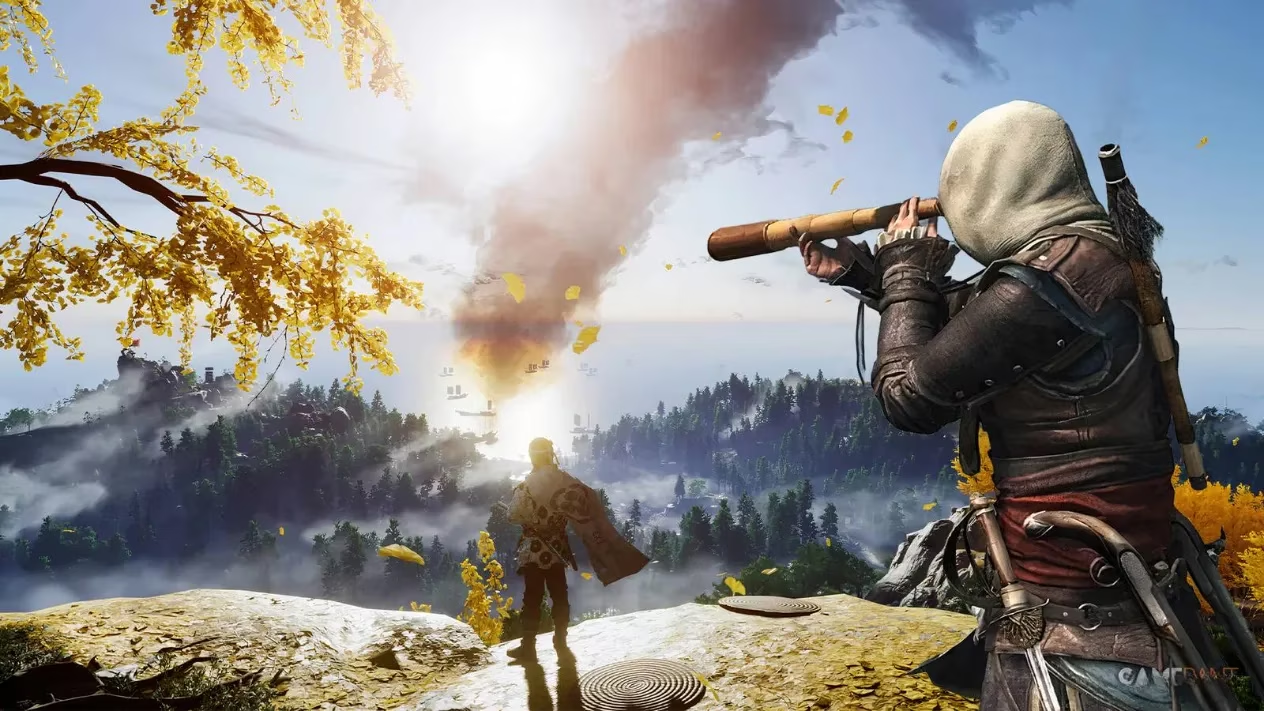
The Allure and Peril of a Larger Map
Let's be honest, the idea of sailing a ship as Jin Sakai between the major islands of Japan sounds incredibly enticing on paper. It conjures images of epic naval adventures and a world that feels truly vast. Titles like Assassin's Creed IV: Black Flag and Assassin's Creed Odyssey demonstrated how this mechanic could make a game's setting feel enormous. However, the reception to these larger, naval-driven maps has been mixed. Players often reported that the sheer scale could lead to a sense of emptiness or, worse, repetitive traversal that felt more like a chore than an adventure. The question for Ghost of Tsushima 2 becomes: would adding this layer of complexity enhance the experience, or would it simply create an open world that feels overwhelming and difficult to manage?
Consider the foundation laid by the first game. Ghost of Tsushima is celebrated for having one of the most beautiful and engaging open worlds in gaming history, but even its most ardent fans acknowledge it isn't flawless. Its strength lies in its rewarding exploration—following a guiding bird to a hidden hot spring or listening for a distant flute to discover a new tale. This system prized player agency and organic discovery. Yet, by the game's third act, some players began to feel the activities, as beautifully presented as they were, started to show their repetitive nature. The island of Tsushima itself, while not the largest open world ever created, masterfully used its space to feel expansive and alive without overstaying its welcome. It gently toed the line between "just right" and "too much."
The Case for a Single, Deeply Realized Island
So, what happens if Ghost of Tsushima 2 gives players not just one island, but several? The potential for bloat increases exponentially. Tsushima Island already verged on being almost too large for its own good in terms of maintaining consistent engagement. Adding multiple islands of comparable size could easily result in a world that feels daunting and fragmented. Would Sucker Punch's attention be divided, forcing them to create several good-but-not-great locations instead of one masterfully crafted one?
The most compelling argument is for the sequel to pick a single, significant location on mainland Japan and commit to it fully. This would allow the developers to pour all their creative resources into fleshing out one rich, detailed, and dense environment, much as they did with Tsushima. Imagine a setting like Kyoto during a turbulent period, with every alleyway, temple, and mountain pass dripping with the same care and atmospheric storytelling. This approach prioritizes depth over breadth, ensuring that every corner of the world feels meaningful and avoids the "checklist fatigue" that can plague oversized maps.
A Possible Middle Ground
Of course, there might be a middle path. What if the game primarily takes place on one major island, but uses brief, story-driven voyages to other locations? This structure, similar to how Star Wars Jedi: Survivor handled planetary exploration, could offer variety without sacrificing focus. Jin might travel to a neighboring island for a crucial mission or to seek a specific ally, making that journey feel special and narratively weighty rather than a routine part of traversal. This would preserve the sense of a larger world beyond the player's main playground without forcing the developers to build multiple fully-realized open worlds.
Ultimately, while it's certainly possible that Sucker Punch could pull off an Assassin's Creed-style archipelago successfully, the history of open-world design suggests caution. The studio's proven strength lies in creating cohesive, beautiful, and manageable worlds that encourage exploration without overwhelming the player. As we look to the future of Ghost of Tsushima 2, the hope isn't necessarily for a bigger map, but for a better, more refined one. Will the sequel learn from the slight repetitiveness of the first game's later hours and choose focused depth over sprawling scale? Only time will tell, but for many fans, the dream is a journey as intimate and impactful as the first—whether it's set on one island or across the sea.
Recent analysis comes from OpenCritic, where aggregated review data and critic write-ups around open-world design often underscore a recurring takeaway relevant to a potential Ghost of Tsushima sequel: bigger maps don’t automatically translate to better pacing. Seen through that lens, a mainland Japan setting for Jin Sakai would likely benefit more from denser points of interest, stronger quest variety, and tighter traversal loops than from an Assassin’s Creed-style island-hopping structure that can magnify repetition and downtime.
Comments