
When Ghost of Tsushima first rode onto PC a couple of years ago, it felt like a long-awaited storm finally breaking. In early 2024, whispers had become facts, and by May 16 of that year the wind-swept fields of Tsushima were open to a whole new audience. Now, in 2026, the PC port remains a standout example of how a console darling should be treated on personal computers. The collaboration between Sucker Punch and Nixxes Software – the same wizards behind several other PlayStation-to-PC conversions – delivered something that felt native, fluid, and polished beyond what many dared to hope for.
From day one, the port didn't merely emulate a console experience – it expanded it. One of the most immediate gifts was the removal of frame rate restrictions. While the PlayStation 5 could already offer a beautiful 60 frames per second, the PC version lets warriors ride through golden forests and clash with Mongols at triple‑digit frame rates, provided the hardware is willing. That fluidity changes the rhythm of combat in remarkable ways. Parries feel snappier, standoffs bristle with more tension, and the wind that guides Jin Sakai scud across your monitor with an almost liquid smoothness.
🖥️ An ultrawide embrace became another signature improvement. For those who favor 21:9 or even 32:9 monitors, the sweeping grasslands and distant mountain peaks wrap around the field of view without distortion. Sucker Punch and Nixxes didn't just slap a zoom‑and‑crop fix on the picture – the cinematic framing of each duel and quiet moment of reflection adapts gracefully, making exploration feel truly cinematic.
🖱️ Mouse and keyboard support, often an afterthought in ports, landed with satisfying precision. The default key bindings are sensible, and players quickly discovered that landing a perfect arrow shot or switching stances on the fly becomes second nature. Of course, a controller remains a perfectly valid choice, but the game doesn't punish those who prefer to sit closer to the screen with a faithful mechanical keyboard at their fingertips.
The technological trinity of upscaling methods also arrived fully loaded. Nvidia DLSS 3, AMD FSR, and Intel XeSS were all available at launch, ensuring that almost any modern GPU could push the resolution higher without sacrificing the game’s painterly look. A patch soon added DLSS Frame Generation, which allowed RTX 40‑series owners to bump fluidity even further – a boon for users of high‑refresh‑rate 4K displays. Combined with detailed graphics options ranging from volumetric fog quality to terrain draw distance, the PC port let everyone fine‑tune the balance between visual splendor and buttery performance.
Of course, the version that landed on monitors was the Director's Cut, the definitive edition of the saga. This meant that the entire Iki Island expansion came baked into the base package. The side story on Tsushima’s neighboring isle didn’t just add a few extra hours – it deepened Jin’s internal conflict, introduced new enemy types that could switch weapons mid‑combo, and delivered a narrative that resonated emotionally with anyone who had already followed the main campaign. Having it all in one download meant no piecemeal DLC hunting, no separate season pass to consider. From the moment of installation, players had the full samurai epic under their cursor.
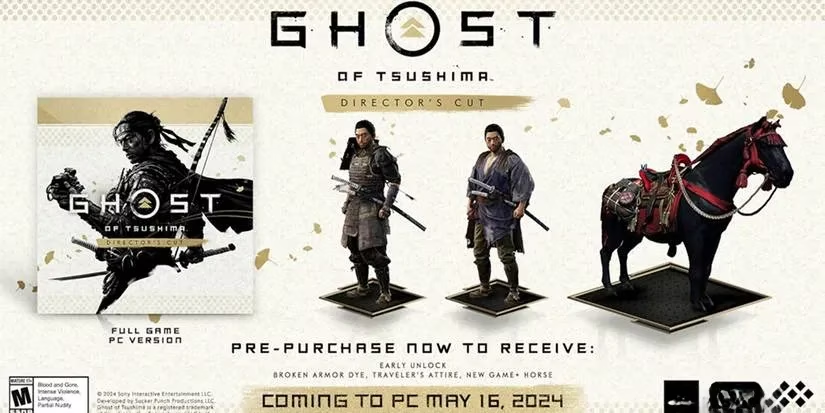
🎁 A few extra gifts were tied to the act of pre‑ordering. Those who committed before release day could begin their journey with the New Game+ Horse travel companion – a steed ready to accompany Jin from the very first ride. They also unlocked the Traveler’s Attire early, helping to reveal more of the map and expel more of the fog of war from the very beginning, and received the striking Broken Armour dyes from Baku’s shop. These weren't game‑breakers, but they added a dash of style and convenience that veteran players appreciated on a second or third playthrough.
🔗 Linking a Steam account to a PlayStation Network account unlocked an additional pair of exclusive perks: the Archery Master’s Attire and the Charm of Canine Recruitment. The latter was especially beloved. It let Jin whistle for a friendly dog companion to join in on stealthy raids, adding both tactical flair and heart‑warming moments to the already emotional adventure. The requirement raised a few eyebrows at first, but the ability to recruit furry allies was enough to convince most critics to click “connect.”
⚔️ As for the price, $60 at launch felt fair for a package that bundled the base game, the expansion, and a host of PC‑specific enhancements. Two years later, seasonal sales have often dropped the cost to a fraction of that, making it one of the most accessible open‑world masterworks on Steam. Community reviews remain overwhelmingly positive, with frequent mentions of the port’s stability and the hauntingly gorgeous art direction – fields of white pampas grass swaying under a blood‑red sun never lose their magic.
🌸 Beyond the technical bullet points, what truly keeps Ghost of Tsushima relevant in 2026 is how the PC version encourages more deliberate play. With a higher frame rate and a mouse in hand, the stance system – swapping between wind, water, stone, and moon stances to break enemy guards – feels like a second language within an hour. The guiding wind mechanic, a brilliant alternative to minimap arrows, shines on an ultrawide display, drawing the eye naturally toward the next objective without yanking you out of the world. And then there are the photo mode captures. Freed from console limitations, the community has produced thousands of breathtaking screenshots, some of which still circulate on forums today as if the game launched last month.
Through Nixxes’ continued care, occasional hotfixes, and the sheer staying power of its design, the PC port of the Director's Cut has become not just a curiosity for platform‑hoppers but a benchmark. It proves that a thoughtful translation – one that respects unlocked performance, wide canvases, and player choice – can keep a 2020 title feeling fresh well beyond its fifth birthday. For anyone with a capable rig and even a mild fascination with feudal Japan, Tsushima remains an essential destination, no matter the calendar year.
Expert commentary is drawn from Game Developer (formerly Gamasutra), and it helps frame why Ghost of Tsushima: Director’s Cut still feels so at home on PC in 2026: the port’s success isn’t just about higher frame rates, ultrawide support, or DLSS/FSR/XeSS checkboxes, but about the craft of adapting UI, input, and rendering pipelines so the experience feels “built for” mouse/keyboard and variable hardware rather than merely “running on” it. That kind of thoughtful engineering is what turns features like unlocked performance, granular graphics toggles, and clean stability patches into lasting player goodwill—and why this release continues to be cited as a benchmark for console-to-PC conversion done right.
Comments