
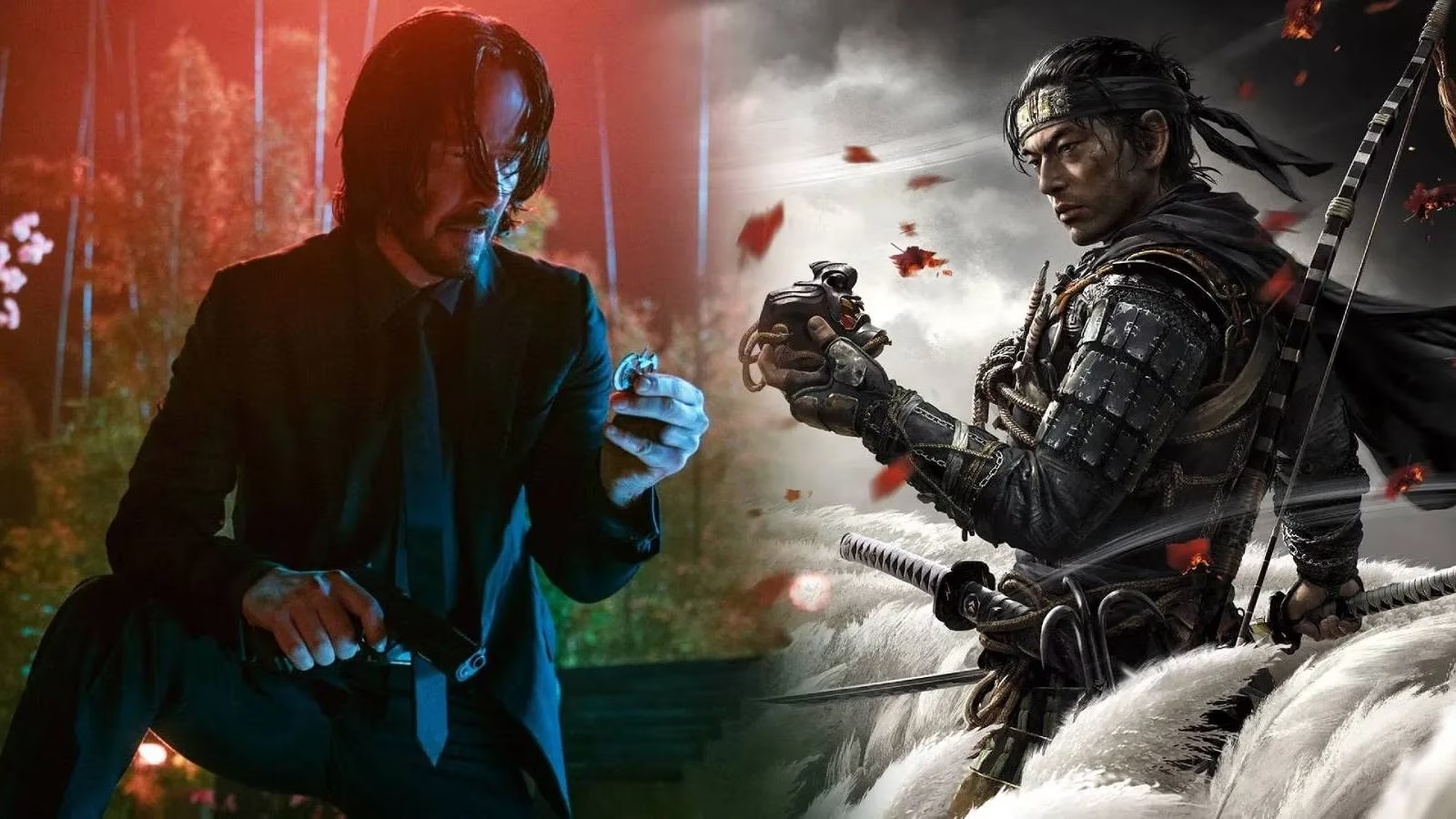
Years of patient anticipation are finally crystallizing into something tangible. Since the initial announcement in early 2021 that a Ghost of Tsushima movie was in development, fans of Sucker Punch’s samurai epic have been riding waves of hope and uncertainty. Hollywood’s track record with video game adaptations was, at the time, a minefield of misfires. But the attachment of Chad Stahelski—the stuntman-turned-director who redefined action cinema with the John Wick franchise—immediately changed the conversation. Now, in 2026, the project has moved decisively past the wishful-thinking phase and into the final stretch of post-production, with Stahelski recently teasing a release window that has reignited global excitement.
Stahelski’s commitment to authenticity has been the North Star from the beginning. When he first spoke about the adaptation, he didn’t just discuss mechanics; he talked about history, texture, and the intangible weight of honor that defines the game. In a career-defining interview back in late 2023, he revealed the script was locked and the team was “very close to getting our s--t together,” a candid moment that happened while Hollywood was still navigating the aftermath of the SAG-AFTRA strikes. Fast-forward to 2026, and that script—crafted by Takashi Doscher—has been the blueprint for a production that unfolded across sweeping locations in Japan and meticulously constructed sets designed to mirror 13th-century Tsushima. The strikes delayed the inevitable, but once cameras rolled in the autumn of 2024, Stahelski and his crew sprinted through a grueling but rewarding shoot that wrapped in late 2025. Post-production has been underway since, with the director personally overseeing the editing rhythm, sound design, and the integration of practical stunts that have become his trademark.
Casting became one of the most closely watched decisions. The game’s protagonist, Jin Sakai, is more than a character—he’s a vessel for the internal clash between samurai code and the ruthless pragmatism of a guerrilla warrior. Daisuke Tsuji, the actor who provided motion capture and voice for Jin, publicly expressed interest in reprising the role early in the development cycle. While Stahelski initially considered a range of Japanese and Japanese-American talents, the creative team ultimately circled back to Tsuji after screen tests demonstrated his unmatched embodiment of Jin’s stillness and fury. 「There was a moment in the audition where he wasn’t performing Jin; he was Jin,」 a producer later recalled. The casting of Tsuji, announced in mid-2024, was met with a collective sigh of relief from the fanbase, and the supporting ensemble features a blend of veteran Japanese actors and rising stars, all performing in period-accurate dialects to honor the game’s language options.
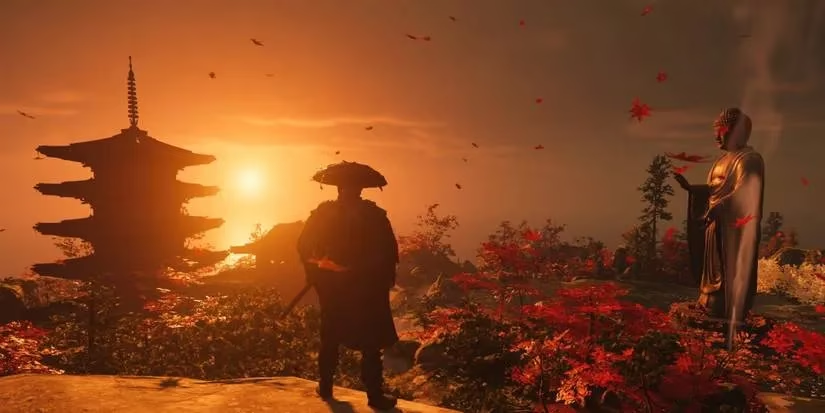
Stahelski’s reverence for Akira Kurosawa runs deep, and it’s the secret weapon of this adaptation. Anyone who watched John Wick: Chapter 4 saw the DNA: the Osaka Continental sequence, with its neon-soaked rooms and sudden, violent stillness, was a love letter to samurai cinema’s framing and pacing. For Ghost of Tsushima, Stahelski abandoned the glossy, hyper-real aesthetic of modern blockbusters in favor of something more elemental. Reports from set visits describe a workflow that used natural light, weather, and long, unbroken takes reminiscent of Seven Samurai and Ran. Sucker Punch even introduced a “Kurosawa Mode” in the game—a black-and-white filter with film grain—and Stahelski has hinted that select pivotal sequences in the movie will pivot to a stark monochrome palette as a direct homage to that feature. 🎥 It’s a bold artistic choice that re-anchors the story in the visual language of the master who inspired it all.
The narrative spine remains intact: Jin’s journey from honor-bound samurai to the spectral “Ghost” who uses fear and shadow as weapons. However, Doscher’s screenplay doesn’t treat the game as a shot-for-shot template. Instead, it expands the internal conflict, weaving in scenes of civilian life, tactical stealth that feels as tense as a heist, and a more pronounced emotional arc for antagonist Khotun Khan. The Mongol invasion is not just a backdrop but a constant, smothering presence, and the film’s structure mirrors the game’s open-world philosophy by giving space to quiet moments—a haiku composed beside a waterfall, a fox guiding the hero toward hidden shrines. These vignettes are carefully paced to avoid the “side-quest” trap that often sinks adaptations. 🦊
Fans of the 2023 Twisted Metal series and the triumphant The Last of Us on HBO have watched the bar for game-to-screen translations soar. Ghost of Tsushima arrives in a landscape where audiences expect emotional depth, not just fan service. Early test screenings in early 2026 have reportedly generated overwhelmingly positive feedback, with viewers praising the kinetic duel choreography and the surprising tenderness between Jin and his uncle, Lord Shimura. The film’s tone balances brutal necessity with poetic restraint, and Stahelski’s insistence on long fight sequences with minimal cuts has drawn comparisons to the golden age of martial arts cinema. 🗡️
As the weeks tick down toward a projected global release in late 2026 or early 2027, the conversation is shifting from “Will it work?” to “How will it redefine what a video game movie can be?” Chad Stahelski didn’t just inherit a beloved IP; he dissected it, studied its ancestors, and rebuilt it with the same obsessive care he brought to building an assassin’s underworld. The result, by all early indications, is a film that stands shoulder to shoulder with the game—a rare feat in an industry that often forgets the soul of its source material. The island of Tsushima is ready for its close-up, and this time, the wind guiding the samurai carries the weight of a master filmmaker’s dream.
Comments