
The live-action Ghost of Tsushima movie has entered a stage that feels less like a sprint and more like a tea ceremony: deliberate, ceremonial, and easily spoiled by haste. In a recent interview with Total Film, later reported by Slash Film, director Chad Stahelski offered a rare status report on the long-gestating project. The good news is that a screenplay now exists. The bad news is that no release date has been announced, and the business machinery is still being tightened.
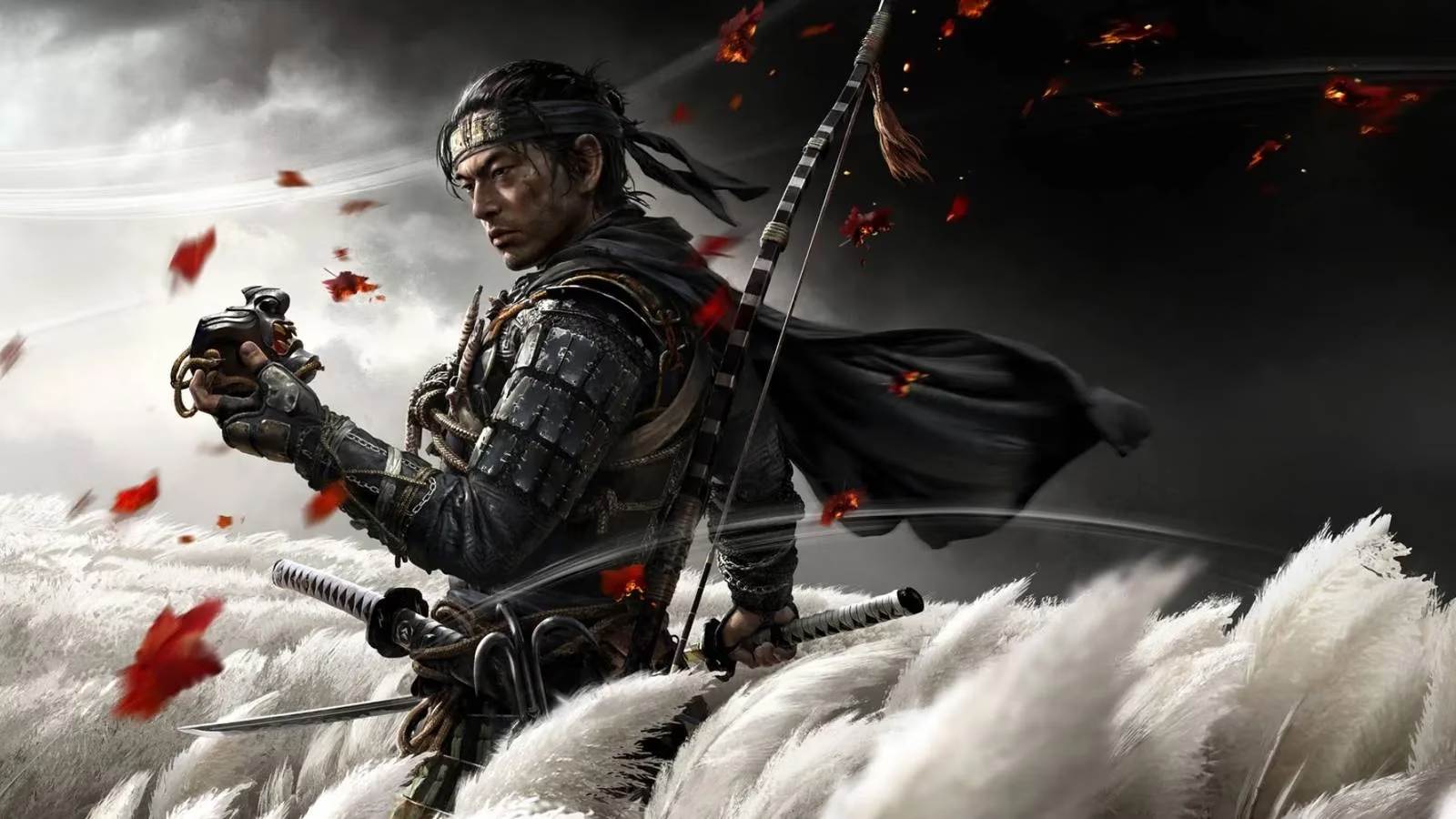
Stahelski said, “We have a really great script. We have a really good creative team behind it. It’s just about getting all the business end of things locked in. It’s kind of in that little bit of flux where everybody is trying to tighten up the deal to get everything going, and to make sure we do the best with it.” For fans, that is both reassuring and frustrating. A finished script is a lantern, not a lighthouse: it illuminates the immediate path but cannot guarantee a safe harbor. The negotiations are the keel beneath the visible hull—boring, essential, and capable of capsizing the entire vessel if warped.
Stahelski did not offer a new release window, but he did emphasize the project’s emotional weight. “Ghost is a special project. Everybody realizes it. Everybody wants to do it,” he said. He also noted that new technologies are being used to bring out the “samurai vibe” of the film, and that he is working to ensure the team “knock it out of the park.” That language matters. It suggests the movie is not a cynical cash-in but a passion project with a director who understands that Ghost of Tsushima’s appeal lies in atmosphere as much as action.
What We Know So Far
| Detail | Status |
|---|---|
| Director | Chad Stahelski |
| Screenwriter | Takashi Doscher |
| Language | Stahelski wants the film entirely in Japanese |
| Cast | Stahelski wants a complete Japanese cast |
| Studio support | Sony is reportedly fully supportive |
| Release date | Not announced |
| Current stage | Script complete; business deals being finalized |
The screenplay is being written by award-winning writer Takashi Doscher. That detail alone gives the adaptation a stronger foundation than many video game movies, which often stumble when they treat source material as a skin rather than a skeleton. Stahelski has also expressed a desire to make the movie entirely in Japanese, with a complete Japanese cast. According to him, Sony is fully supporting this approach, which means it could actually happen. In an industry where subtitles are still treated like a commercial hex, that commitment gives the project the texture of a hand-forged blade rather than a mass-stamped replica.
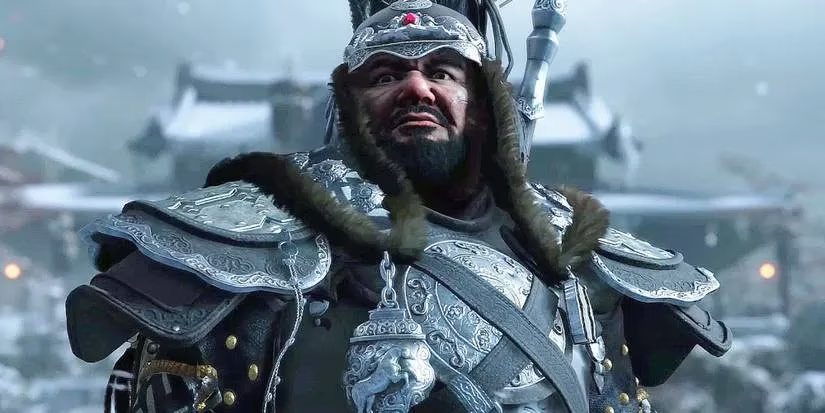
That choice would be crucial. Ghost of Tsushima draws deeply from Japanese history, samurai cinema, and the visual language of Akira Kurosawa. Jin Sakai’s journey across Tsushima is not merely a revenge plot; it is a story about identity, honor, and the cost of survival. The game’s cinematic DNA—duels in moonlit fields, the wind guiding players through pampas grass, the menace of Khotun Khan—makes it a natural candidate for live action. But it also raises the stakes. A Japanese-language production with an authentic cast would honor that DNA. A generic Hollywood version would risk turning a katana into a prop.
Stahelski’s Busy Horizon
Stahelski’s schedule is another variable. He was recently announced as the director of the Rainbow Six movie, with Michael B. Jordan set to lead and reprise his role as John Clark from Without Remorse. That project adds another major franchise to his plate, alongside his work on the John Wick universe. A director’s attention is a finite resource, and Ghost of Tsushima needs more than a name attached; it needs focused craftsmanship. Still, Stahelski’s background in practical action and long-take choreography makes him an intriguing fit for a game built on precise swordplay.
Sony’s Adaptation Gold Rush
Sony, meanwhile, has been doubling down on adapting its exclusive games into movies and television. The Last of Us became a record-breaking phenomenon shortly after its release. A Gran Turismo movie moved forward and reached theaters. Amazon secured the rights for a God of War TV show, and a Horizon Zero Dawn adaptation entered development at Netflix. By 2026, that strategy looks less like an experiment and more like a gardener grafting game franchises onto film and television rootstock. Some grafts have taken; others are still wrapped in protective tape.
Ghost of Tsushima occupies a special place in that slate. It is not just another PlayStation property. It is a game that already feels like a film, with a protagonist who moves like a wandering ronin and a world that breathes in wind and weather. The movie’s challenge is not merely to replicate combat animations. It is to capture the quiet before a duel, the weight of a promise, and the melancholy of a blade drawn for the wrong reason.
The Waiting Game
As of 2026, the Ghost of Tsushima movie still has no release date. The script is in place, the creative team is assembled, and Sony’s support for a Japanese-language approach remains a promising sign. But “business flux” is not a marketing slogan. It is a reminder that films are not willed into existence by fan enthusiasm alone. They are financed, scheduled, insured, and negotiated into being.
For now, the project resembles a samurai standing at the edge of a storm: every step is deliberate because a single misstep could be fatal. The good news is that the blade has been forged. The bad news is that the battle has not yet begun. Fans of Ghost of Tsushima should keep their expectations sharp but patient. If Stahelski and his team can lock in the deals and preserve the game’s soul, the result could be one of the rare adaptations that earns its place beside the original. If not, it will become another cautionary tale about a beautiful script that never found its way to the screen.
Comments