
I still remember the moment the announcement dropped. It was March 2024, and my Twitter feed exploded with that iconic image: Jin Sakai standing in a field of pampas grass, with a simple tagline confirming what many of us had long hoped for. After years of rumours, the legendary PlayStation exclusive was finally making its way to PC. On May 16, 2024, Ghost of Tsushima Director's Cut arrived on Steam and the Epic Games Store, and I was one of the thousands who stayed up late just to click 'Install' the second it went live. Now, in 2026, I find myself returning to Tsushima Island once again – and it still takes my breath away.
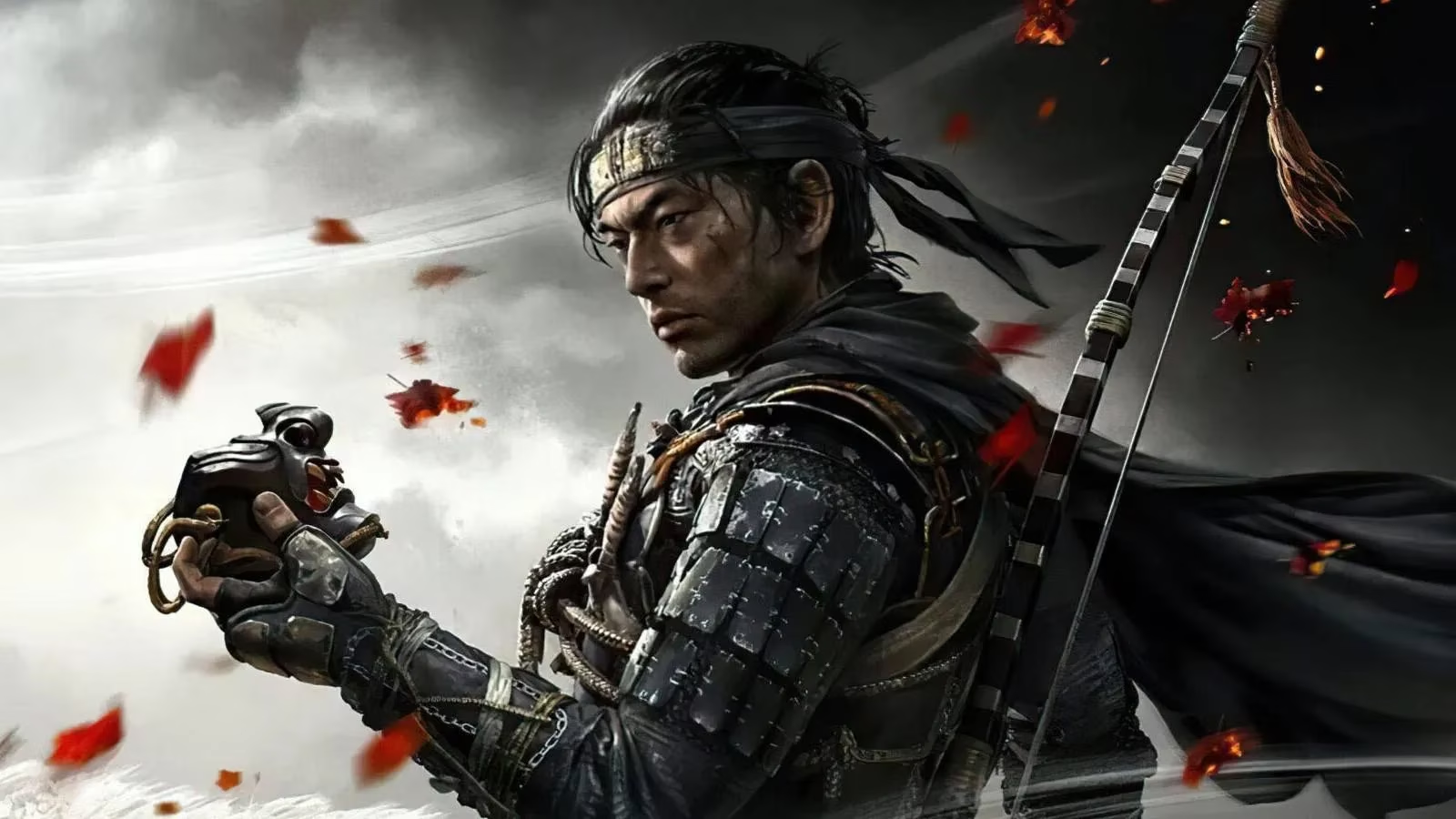
The port was handled by Nixxes Software, the studio that had already earned a sterling reputation for bringing Marvel's Spider-Man Remastered and Ratchet & Clank: Rift Apart to PC with impeccable quality. From day one, the PC version came with all the bells and whistles we could ask for. Ultrawide monitor support was a headline feature: the game looked absolutely stunning spread across a 32:9 display, and the ability to use triple monitors with 48:9 resolutions turned my setup into a samurai cinema experience. Combine that with uncapped frame rates, and I was slicing through Mongols at over 120fps without a single stutter.
But what really sealed the deal? The inclusion of NVIDIA DLSS 3 and AMD FSR 3. Even today, as newer titles push graphical boundaries, the upscaling and frame generation technologies in Ghost of Tsushima remain a benchmark. I recently reinstalled the game on my RTX 5070 (yes, the 5000 series is finally here, and it feels like overkill for this title) and let me tell you – running at 4K with DLSS Quality and frame generation, the world feels almost unnaturally smooth. Intel XeSS support also meant that my friend with an Arc GPU could join me without any performance hiccups.
Nixxes didn't stop at visuals. The customisation options for keyboard and mouse were deep and satisfying, but I always preferred the immersion of a controller. Plugging in the PlayStation DualSense brought haptic feedback and adaptive triggers directly to my desktop, letting me feel the tension of Jin's bowstring or the clash of steel in a duel. Steam Input support also meant I could remap any controller to my liking – a feature that modding communities have since used to create wild control schemes for challenge runs.
Speaking of pre-orders, I took the plunge early and got some neat bonuses: a special New Game+ horse with a striking saddle, the Traveler’s Attire that made hunting for collectibles less tedious, and those Broken Armor dyes from Baku’s shop which let Jin’s battle-scarred gear look even more badass. Two years on, those digital trinkets don’t affect gameplay, but they serve as a nice reminder of the launch day excitement.
Now, the question I get asked most often in 2026 is: “Is it still worth picking up Ghost of Tsushima on PC?” Let’s break it down with a quick snapshot of what the Director’s Cut includes even today:
-
🗺️ The complete base game plus the Iki Island expansion, which adds a darker, more personal story and some of the best combat encounters.
-
⚔️ The multiplayer Legends mode, which has seen steady updates and still boasts a surprisingly active community. You can find co-op matches within seconds.
-
🖥️ Full ultrawide support (21:9, 32:9, and even 48:9 triple-monitor setups) for a cinematic experience no console can match.
-
⚙️ Advanced graphics settings with DLSS 3, FSR 3, and XeSS – future-proofed for years to come.
-
🎮 Native DualSense features and unrestricted controller remapping.
I’ve seen some sceptics ask whether a 2020 game can hold its own against more recent samurai epics. My answer is always the same: Ghost of Tsushima wasn’t just a visual showcase; it was a masterclass in atmosphere, combat flow, and minimalist storytelling. The wind-guided navigation, the haiku writing spots, the hot springs – every mechanic reinforces a meditative connection to the world that feels just as refreshing in 2026 as it did at launch. The combat remains tight and responsive, the standoff mechanic never gets old, and the stealth, while not as deep as a dedicated ninja simulator, lets you ghost through encampments with lethal elegance.
And let’s not forget the modding scene. Over the last two years, the PC community has produced texture overhauls, gameplay tweaks, and even custom legends missions. A recent “Kurosawa Mode Enhanced” mod makes the black-and-white filter even more authentic to classic cinema, something I wholeheartedly recommend for a second playthrough.
Price-wise, the Director’s Cut frequently goes on sale for less than half its original cost, and at that value, it’s practically theft. Even at full price, the sheer volume of content – easily over 60 hours with the Iki Island expansion and Legends – makes it a no-brainer for anyone who missed the PlayStation era.
So, as I watch Jin Sakai bow silently before another fox shrine, I realize that Ghost of Tsushima on PC isn’t just a port. It’s the definitive way to experience Sucker Punch’s magnum opus. The 2024 release may feel like yesterday’s news, but its legacy has only grown. If you’ve ever wanted to lose yourself in a wind-swept, blood-soaked journey honouring the samurai code, there has never been a better time to draw your katana. The Mongols are still waiting – and this time, you can face them in 48:9.
Comments