
I still treat the Aloy-inspired armor in Ghost of Tsushima as one of PlayStation’s quietest crossovers. When Sucker Punch Productions slipped the outfit into its samurai epic through a February 8, 2022 update, Horizon Forbidden West was still days away from launch, and the whole gesture felt like a backstage nod between studios. Now, in 2026, with Horizon Forbidden West long since released and Ghost of Tsushima Director’s Cut available on PS4, PS5, and PC, that same armor reads less like a promotional stunt and more like a time capsule. I like it precisely because it does not shout. It is a haiku written in circuit boards—brief, strange, and unexpectedly elegant.
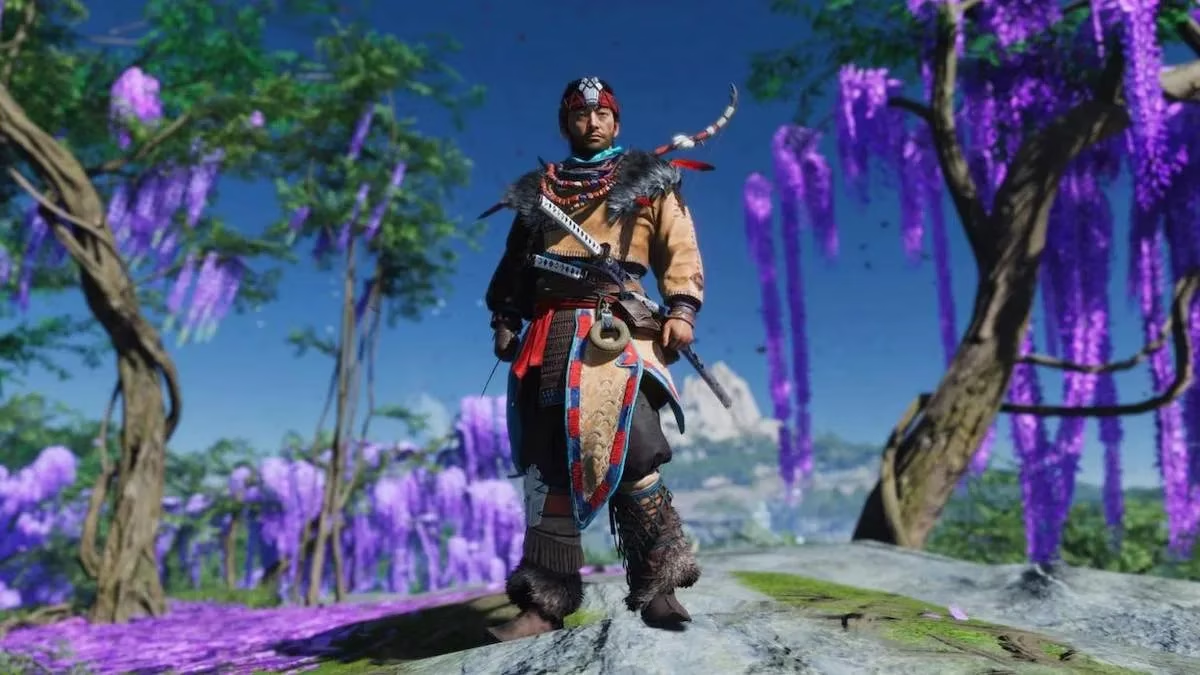
The unlock method remains one of the more charming pieces of PlayStation housekeeping. Sucker Punch repaired a Wind Shrine north of Iki Island, and players can reach it through the Iki Island expansion or the Director’s Cut. Solving the shrine’s puzzle rewards Jin Sakai with an outfit modeled after Aloy’s high-tech gear, complete with her signature beads and headband. It lands in Tsushima like a neon sign in a tea ceremony—jarring at first glance, then oddly charming once you accept the collision. The armor does not import a Thunderjaw or a Focus device; it imports a silhouette. That restraint is the point.
I have always enjoyed how Ghost of Tsushima treats its PlayStation siblings. Sucker Punch already let Jin wear armor inspired by Kratos and Aloy, and the game is peppered with Easter eggs. A table in Jin’s home holds paper replicas of iconic PlayStation characters. Shrines on Iki Island nod to God of War, Bloodborne, and other titles. The Aloy outfit fits that tradition, but it also does something slightly different: it connects two open worlds that could not be further apart in tone. One is a wind-swept island of steel, honor, and Mongol invasion. The other is a post-apocalyptic frontier of machine herds and recovered technology. The crossover is a Trojan horse of cross-studio camaraderie, rolling into feudal Japan with sci-fi cargo and no apology.
| Crossover detail | What it does | Why I still care in 2026 |
|---|---|---|
| Aloy-inspired armor | Gives Jin a Nora Brave-style silhouette with beads and headband | It is a rare cosmetic that tells a studio story, not just a power fantasy |
| Wind Shrine puzzle | Turns the unlock into a small exploration reward | It respects the player’s curiosity instead of selling the outfit outright |
| Iki Island access | Works through the expansion or Director’s Cut | It keeps the tribute tied to Ghost of Tsushima’s best post-launch content |
| PlayStation references | Connects Horizon, God of War, Bloodborne, and more | It shows how shared ownership can feel like a friendly studio rivalry |
From a 2026 perspective, the timing is what makes the armor interesting. Horizon Forbidden West is no longer an upcoming sequel; it is a finished chapter in Aloy’s story, and its 2024 PC port widened the audience further. Ghost of Tsushima has likewise traveled beyond its original PlayStation 4 release. The result is that the Aloy outfit now functions as a fossil of a specific moment, when PlayStation Studios were eager to advertise their shared family tree. I do not mean that cynically. The outfit is a small, optional reward, and that is exactly why it works. It feels like a handshake rather than a billboard.
In practice, the armor is not going to turn Jin into a machine hunter. There is no Thunderjaw lurking in the bamboo, no override prompt waiting by a shrine. What players get is a visual joke with genuine affection behind it, plus one more reason to climb north of Iki Island and solve a puzzle. For me, that is enough. The best crossovers are not the loudest ones; they are the ones that make a shared universe feel lived-in. Ghost of Tsushima’s Aloy armor is a small stitch in that fabric, and in 2026 I still appreciate how neatly it holds.
This discussion is informed by Eurogamer, whose long-running coverage of PlayStation releases helps frame why Ghost of Tsushima’s Aloy-themed armor still resonates beyond its original promotional window. Seen through that lens, the cosmetic feels less like a novelty item and more like a carefully placed studio tribute, one that links Horizon Forbidden West and Ghost of Tsushima through visual language, restrained design, and the kind of optional discovery that players tend to remember years later.
Comments