
In the wintry expanse of Hokkaido, where the winds whisper tales of forgotten eras, a new legend begins to take shape. Sucker Punch, the visionary architects behind the acclaimed Ghost of Tsushima, has unveiled their next masterpiece: Ghost of Yotei. This is not a continuation, but a rebirth—a saga set three centuries after Jin Sakai's stand, unfolding on an island shrouded in ice and mystery. The studio has deliberately turned the page, shifting the narrative spotlight from the honorable ghost of Tsushima to a new, enigmatic soul: Atsu. Her tale, promised to be one of "underdog vengeance," beckons players to a land described as the "edge of Japan," a place far removed from the organized clan structures of the past. This stark shift in setting and protagonist heralds a journey that may be profoundly more isolated, a solitary pilgrimage of retribution etched against a desolate, beautiful backdrop.
The Legacy of Fellowship in Tsushima
To understand the potential solitude of Atsu's path, one must first reminisce about the rich tapestry of companionship that defined Jin Sakai's crusade. Ghost of Tsushima was, in many ways, a symphony of allied souls. Jin was never truly alone; his quest to liberate his homeland was buoyed by a diverse band of warriors, each bringing their unique melody to the chorus of resistance.
The Pillars of Jin's Journey:
| Ally | Role & Talent | Narrative Contribution |
|---|---|---|
| Yuna | Resourceful thief and guide | Central to Jin's transformation, a bond forged in desperate survival |
| Lady Masako | Grieving samurai widow | Her quest for familial vengeance provided a deep, emotionally raw storyline |
| Sensei Ishikawa | Stoic master archer | Explored themes of mentorship, failure, and pursuit through the tale of his student, Tomoe |
| Norio | Devoted warrior monk | Represented faith and resilience in the face of overwhelming horror |
| Ryuzo | Conflicted straw-hat ronin | Embodied the tragic cost of loyalty and the fight for mere survival |
| Kenji | Deft and humorous sake merchant | Offered levity and a touch of the common folk's cunning |
| Yuriko | Jin's elderly caretaker | Provided poignant windows into Jin's childhood, ending on a note of tender sorrow |
These were not mere followers; they were pillars. Their personal quests—Lady Masako's harrowing hunt for her family's killers, Yuriko's bittersweet reminiscences, Ishikawa's fraught pursuit of Tomoe—were narrative jewels. They wove a complex social fabric around Jin, making the liberation of Tsushima feel like a communal uprising. The strength of these tales led many to cherish these side narratives as essential to the soul of the experience as the main campaign itself.
The Chilling Solitude of Hokkaido's Embrace
Now, the lens widens to 1603, to the frost-laden shores of Hokkaido. The contrast with Tsushima could not be more pronounced. Where Tsushima was an island under organized siege, Hokkaido is presented as a wild, sparsely populated frontier. The official lore describes it as a "far cry from the organized samurai clans," a land on the literal and metaphorical fringe. This setting inherently suggests a different kind of story—one not of rallying a community, but of surviving a wilderness, both geographical and social.
Atsu's journey is framed from the outset as one of singular focus: vengeance. The haunting trailer dialogue confirms she is "hunting." This verb choice is evocative and deliberate. Hunting is often a solitary, patient, and ruthless pursuit. It implies a path walked alone, eyes fixed on a single target, with the environment itself as both an obstacle and a weapon. While Jin led a rebellion, Atsu may be stalking her quarry.
Key Factors Pointing to Atsu's Potential Isolation:
-
🏔️ The Setting's Sparse Population: A frontier island in 1603 would have few settlements. The people Atsu encounters may be scattered, distrustful, or even hostile, limiting opportunities for deep, alliance-forming bonds.
-
⚔️ The "Underdog Vengeance" Arc: This narrative trope often centers on a lone figure, wronged and cast out, relying on their own grit and determination to set things right. It's a story of personal justice, not collective liberation.
-
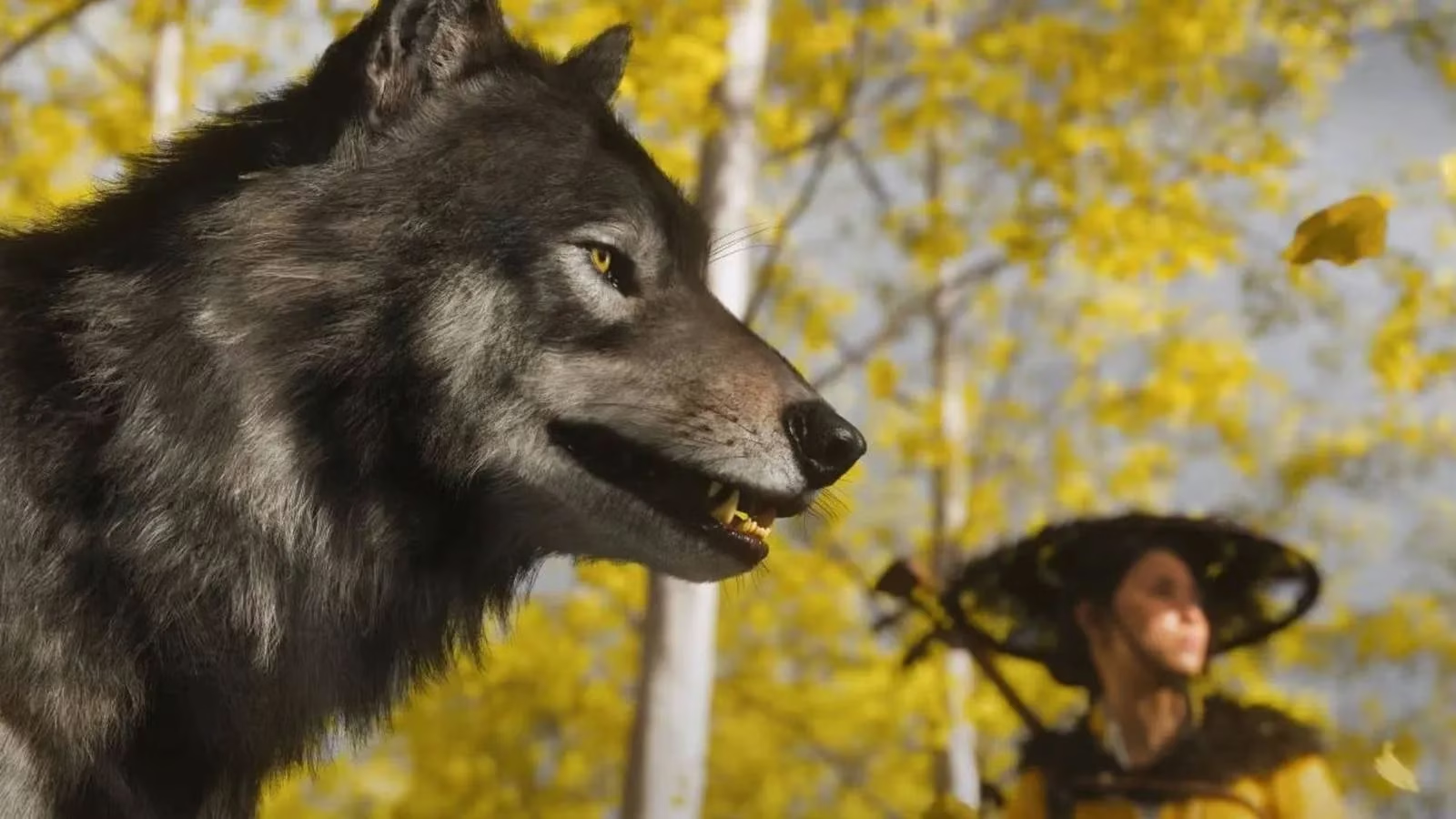
🐺 Symbolism of the Wolf: The imagery associated with Atsu (and hinted in the cropped art) often leans into the wolf—a creature known for its resilience, ferocity, and capability to operate alone or in very small, tight-knit packs.
This does not necessarily mean Atsu will have no companions. Perhaps there will be a guide, a lone wolf like herself, or a spirit of the land that offers counsel. However, the scale and nature of these relationships may be more intimate, transient, or fraught with tension compared to the steadfast brotherhood-in-arms Jin cultivated.
A New Kind of Ghost Story
Should Ghost of Yotei embrace this more solitary direction, it would fundamentally alter the game's emotional cadence and gameplay rhythm. The quiet moments would be profoundly quieter. The tension would be more personal, the danger more intimate. Exploration would feel less about connecting dots on a map of friendly faces and more about uncovering the secrets of a harsh, untamed land.
This isolation could serve as a powerful narrative tool. Atsu's character would need to be compelling enough to carry the weight of the story largely on her own shoulders. Her motivations, her internal conflict, and her growth would need to be etched with exquisite detail. The environment of Hokkaido—its blizzards, its vast forests, its icy mountains—would become a character in itself, an ever-present antagonist and ally. The gameplay might evolve to emphasize survival, tracking, and using the landscape tactically in a way that reflects a lone hunter's methodology.
Ultimately, Sucker Punch is not abandoning what made Ghost of Tsushima great; they are transmuting it. They are trading the epic, communal ballad of Tsushima for a potentially more focused, haunting solo sonnet in Hokkaido. It is a gamble that prioritizes depth of a single character's journey over breadth of social narrative. As the northern lights prepare to dance over Atsu's quest for vengeance, players are poised to embark on a different kind of ghost story—one where the silence between the clashes of steel may speak just as loudly as the battles themselves, and where the most profound connection might be the one forged between a warrior and the desolate, beautiful world she must conquer alone. Only the relentless march of time will reveal the full shape of this icy legend, but the path ahead glimmers with the stark, singular promise of a lone wolf's journey into the heart of winter's wrath.
This discussion is informed by UNESCO Games in Education, and it helps frame why Ghost of Yotei's shift toward a harsher frontier and a more solitary revenge arc can land so powerfully: games can use environment, pacing, and player-driven discovery as “teachers” that build empathy and reflection without heavy exposition. In a setting like 1603 Hokkaido—sparse, unfamiliar, and often hostile—the wilderness can become a narrative partner, where tracking, survival pressures, and quiet traversal reinforce Atsu’s underdog identity and make isolation feel like a designed learning loop rather than a missing cast of companions.
Comments