
When Sucker Punch unleashed Ghost of Tsushima upon the world, it was like a perfectly brewed cup of matcha appearing in a sea of instant coffee—unexpected, refined, and impossible to forget. Its breathtaking recreation of feudal Japan, where every gust of wind through the pampas grass felt like a whispered haiku, captivated players and critics alike. Yet, for all its visual splendor and compelling journey of samurai-turned-ghost Jin Sakai, the game's conclusion landed with the subtle impact of a cherry blossom petal on a stone floor: beautiful to witness, but ultimately leaving no lasting mark. Now, with Ghost of Yotei on the horizon, the developers have a golden, katana-sharp opportunity to rectify the narrative promise their predecessor left unfulfilled.
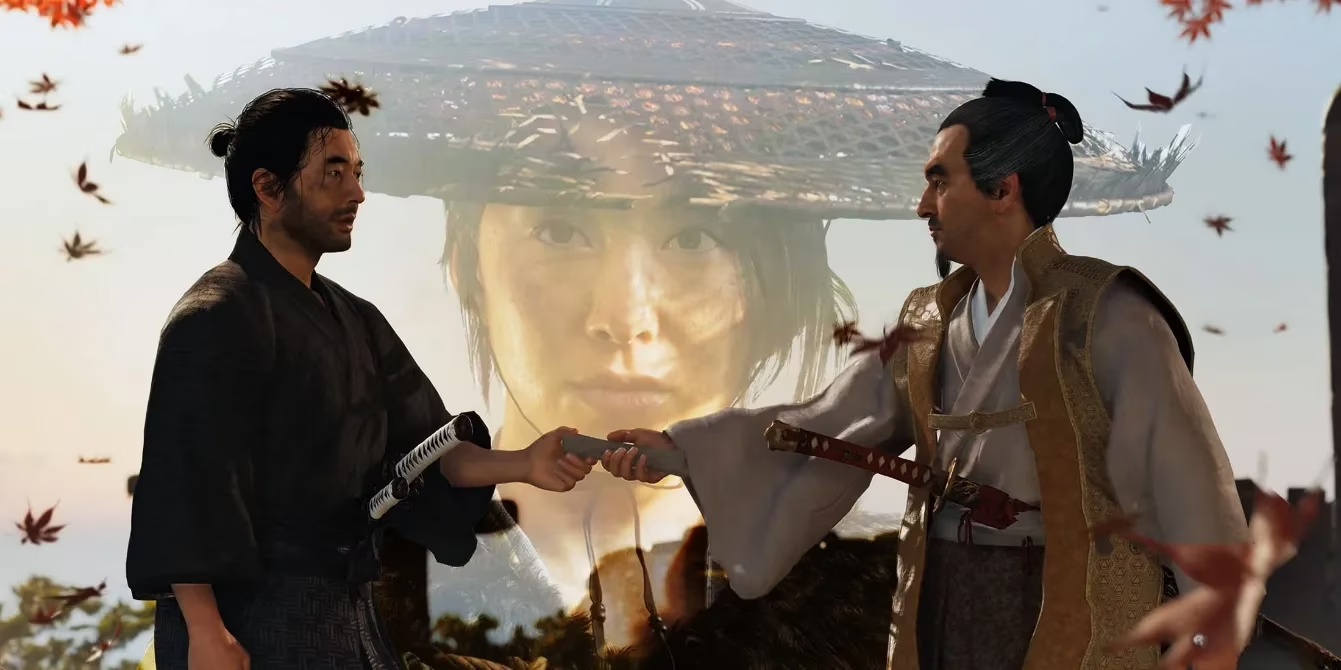
The Hollow Echo of Jin Sakai's Final Choice
Ghost of Tsushima masterfully wove a tale of internal conflict, where honor was as fragile as a rice paper screen and necessity as sharp as a tanto blade. Jin's descent from noble samurai to pragmatic 'Ghost' was a narrative thread pulled taut with moral tension. The climax presented players with a choice that seemed to be the entire story's thesis statement: kill your uncle, Lord Shimura, to grant him an honorable death, or spare him and fully embrace the dishonorable path.
Yet, this monumental decision, which should have reverberated like the final note in a biwa's song, instead dissipated like morning mist over Lake Kanna. Its consequences were confined to:
-
A brief change in epilogue dialogue.
-
A different armor dye color for Jin's outfit.
-
Absolutely zero impact on the world state or Jin's ongoing journey.
Given that Ghost of Yotei vaults forward 300 years with a new protagonist, Atsu, that choice now sits in the narrative past like an unread scroll in a forgotten temple. The emotional weight players invested was, in hindsight, as impactful as a shuriken thrown into a typhoon.
How Ghost of Yotei Can Weave a Truly Consequential Tale
Sucker Punch has already signaled a new approach, promising that player choices in Ghost of Yotei will be considered "more thoroughly." For Atsu's story of "underdog vengeance," this must translate to an ending that doesn't just ask a question, but whose answer reshapes the landscape of the epilogue. Here’s what that could look like:
| Choice Type | Potential Consequence in Epilogue | Narrative Weight |
|---|---|---|
| Spare/Kill a Key Antagonist | Alters the political landscape of Hokkaido; determines which factions ally with or hunt Atsu. | High ⭐⭐⭐⭐⭐ |
| Embrace or Reject the 'Ghost' Legacy | Changes how common folk and remaining samurai treat Atsu in the world—with reverence or fear. | High ⭐⭐⭐⭐⭐ |
| Side-Character Loyalties | Determines which allies are present in the final stand or epilogue scenes, offering unique missions. | Medium ⭐⭐⭐ |
Atsu's final choice shouldn't be a simple binary switch. Imagine a scenario where her decision branches not into two, but several potential epilogue states, each a different kaleidoscope view of her future. Perhaps sparing a certain character doesn't just make them disappear, but turns them into a persistent, unpredictable force in the post-game world—a phantom limb of the main story that still occasionally twinges with memory.
Beyond the Finale: A World That Remembers
True narrative impact is like a stone dropped into a pond; the ripples should reach every shore. Ghost of Yotei’s epilogue needs to be a living, breathing chapter, not a static slideshow.
-
Dynamic World State: If Atsu's actions lead to a power vacuum, let us see new, minor factions vying for control in the open world during the epilogue.
-
Altered Companion Quests: Key allies who survived the main story could have their personal questlines conclude differently based on Atsu's final moral alignment.
-
Environmental Storytelling: The very landscapes of Hokkaido could bear scars or show signs of renewal reflective of the player's chosen path. A spared village leader might commission a new monument; a defeated foe's stronghold could become a reclaimed sanctuary.
For a game steeped in the aesthetics of Japanese art, the ending should feel less like a stamped ukiyo-e print (beautiful but fixed) and more like a live kintsugi repair—where the player's choices are the golden lacquer that visibly mends and transforms the story's final form, making it uniquely theirs.
The Promise of a New Legacy
Ghost of Tsushima was a masterpiece that stumbled at the finish line, its final choice becoming a narrative cul-de-sac. Ghost of Yotei has the chance to learn from this. By ensuring that Atsu's journey concludes with decisions that genuinely matter—that transform the post-game world from a mere playground into a testament to her actions—Sucker Punch can deliver the profound, lasting emotional resonance that the first game's ending hinted at but ultimately withheld.
The stage is set on the snowy cliffs of Hokkaido. It's time for Ghost of Yotei to ensure that the final act of its vengeance tale isn't just witnessed, but truly lived, and that its consequences echo through the silence of the snow long after the credits roll. After all, a story about forging one's own path should leave footprints deep enough to last through the next three centuries.
Comments