
It has been over half a decade since Ghost of Tsushima galloped onto PlayStation 4 and instantly redefined the samurai open-world experience, and two full years since Team Ninja's ambitious Rise of the Ronin tried to capture that same lightning in a bottle. Both games thrust players into breathtaking visions of feudal Japan, yet they land in completely different eras and mindsets. Even now, in 2026, the conversation refuses to die down – which game’s world truly feels more alive, more worth getting lost in? By putting their maps under a magnifying glass, it becomes clear that a nearly identical square mileage can tell two dramatically different stories.
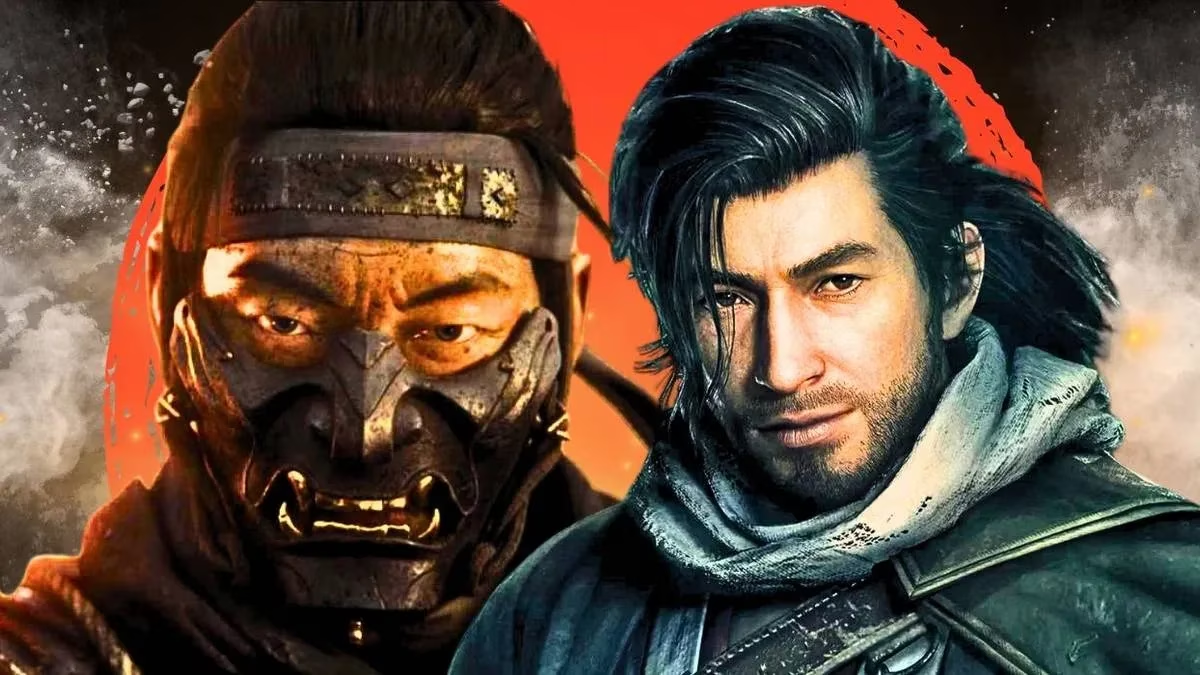
On raw numbers alone, the playing fields are eerily matched. Rise of the Ronin’s patchwork of provinces clocks in at 10.4 square miles, practically nose-to-nose with Ghost of Tsushima’s 11 square miles. But here's the rub – size isn't everything, and both games unfold their geography in ways that feel miles apart. Ghost of Tsushima treats its island like a living scroll being unrolled vertically; you push northward with Jin Sakai, the land slowly opening up as the Mongol invasion story demands. It is a masterclass in narrative-driven exploration, where every liberated farmstead feels like reclaiming a piece of the island's soul.
Rise of the Ronin, on the other hand, immediately throws open the gates to Yokohama, gifting players a chunky lateral slice of its world right off the bat. Just when you start thinking you have seen the full picture, it yanks you into entirely disconnected mega-cities – Edo and Kyoto – as standalone sandboxes. The sensation is less a continuous journey and more a series of breathtaking dioramas. Honestly, it is a little jarring at first, but it cleverly mirrors the fragmented political landscape of the Bakumatsu period.
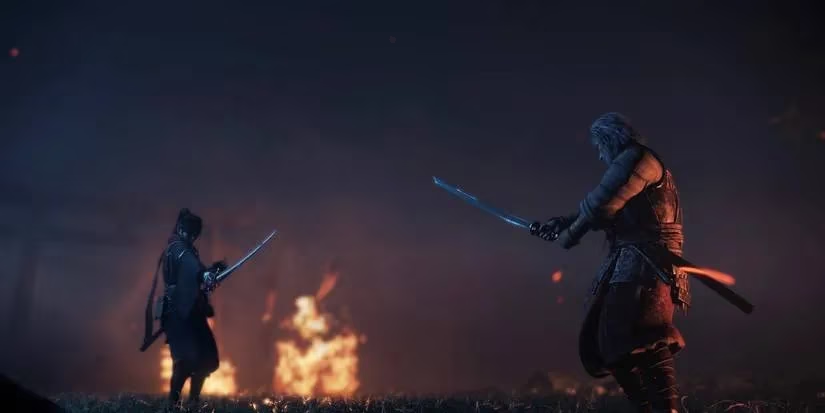
When it comes to pure environmental eye candy, Ghost of Tsushima still wears the crown with effortless grace. Sucker Punch’s Tsushima island is a mood ring come to life. One moment you are cantering through fields of pampas grass that ripple like golden silk, the next you are weaving through snowy mountain passes or standing in a forest of vibrant red maples. The map breathes, its biomes shifting with a poetic rhythm that makes aimless wandering feel like a deep meditation. Rise of the Ronin, let’s face it, plays things much safer. Its countryside is a seemingly endless patchwork of thin, green forests and sleepy villages that blend into one another. The grass is nice, the trees are nice, but after a dozen hours, the terrain can start to feel like one repeated note – a bit of a one-trick pony in the visual department.
However, just when you are ready to dismiss the newer title’s world, it plays its trump card: urbanization. Set in the late 1800s, Rise of the Ronin boasts something Ghost of Tsushima could never dream of – genuine, sprawling cities. Yokohama, Edo, and Kyoto are not just oversized forts; they are bustling hubs with a scale reminiscent of Red Dead Redemption 2’s Saint-Denis. There is an electric thrill in navigating crowded streets as a lowly ronin, brushing past merchants, witnessing period architecture, and feeling the pulse of a society on the brink of modernization. It is a structural marvel that makes Tsushima’s isolated castles feel charmingly antiquated by comparison.
Yet a map is more than a postcard; it is a playground. Here, the six-year gap between the games hasn't widened any chasm – instead, it highlights where Rise of the Ronin stumbles in the exploration department. The heart of any great open world lies in its distractions, and Ghost of Tsushima’s Tales of Tsushima remain the gold standard. Side quests centered on complex figures like Sensei Ishikawa or Lady Masako are more than errands; they are poignant, character-rich vignettes that pull you deeper into the world’s emotional fabric. They make you want to chase every question mark on the map.
Rise of the Ronin, sadly, skimps on this soul. Too many of its side activities dissolve into repetitive busywork without narrative payoff. There is no equivalent to stumbling upon a random stranger in need who leads you to a hidden fox den or a steamy hot spring. Even random roadside encounters, which should make the world feel unpredictable, often fall flat – groups of enemies attack the player for little to no discernible reason, breaking immersion rather than enhancing it. In Tsushima, you always knew the Mongols or bandits were the enemy; in Rise of the Ronin, some vagrants just seem to have a really bad day and take it out on you. It’s a bummer that pulls the rug out from under the game's own attempt at a living world.
By 2026, both titles have settled into their legacies. Ghost of Tsushima’s Director’s Cut, with its Iki Island expansion, only deepened an already generous world, adding layers of hallucinatory wildness and heartfelt stories. Rise of the Ronin offers thrilling, bone-crunching combat and a genuinely ambitious urban spectacle, but its open world often forgets to fill the spaces between the fight clubs with meaningful life. The maps may be nearly identical in surface area, but one feels like a rich anthology of tales whispered on the wind, while the other too often remains just a very pretty, historically accurate grid. For all its swordplay panache, Rise of the Ronin can’t hold a candle to the soulful, wandering spirit of Tsushima.
Comments